
AI in Radiology - Pros and Cons
Summarize this article with:



Radiology has truly moved from low-stress, systematic medical domain to unexpectedly chaotic, and exhausting fields. Radiologists are constantly balancing between speed and accuracy due to countless medical images to attend without any room for misinterpretation.
Due to continuous spikes in imaging volume, it has become mandatory to find a better solution to make this process faster and more organized.
At this phase, AI takes over: not by replacing radiologists but by automating case triaging, prioritizing urgent patients, detecting microscopic details and supporting clinical decisions.
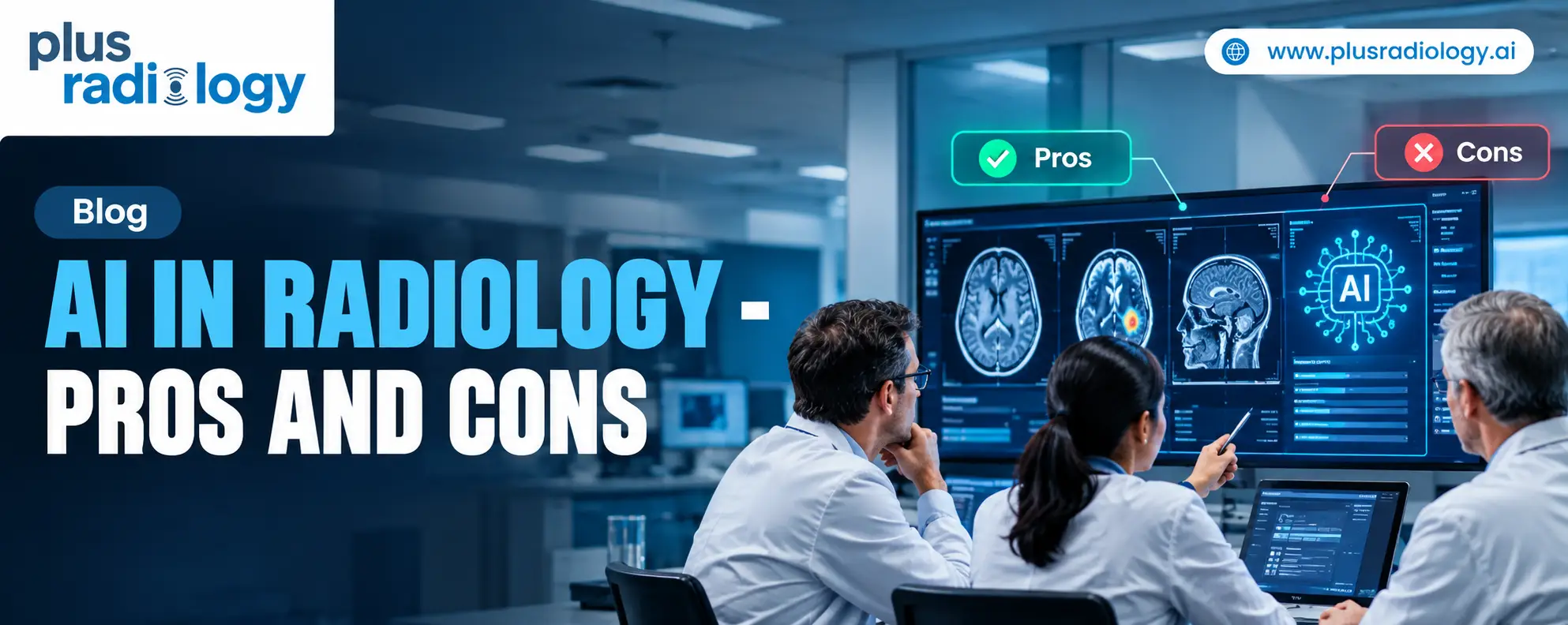
But like any technology, it has its own limitations too. In this blog, we’ll look at key pros and cons of AI in radiology to understand where it helps and where caution is needed.
Advantages of AI in Radiology
AI is not just about advanced technology – it can also bring some significant improvements to the day-to-day running of radiology clinics. Let’s talk about them in detail.
Faster Image Analysis
AI can analyze medical images quickly and identify areas that may require further attention. It can process large volumes of images and assist radiologists in detecting potential abnormalities without manually reviewing every image in the same way.
Get instant replies to all your queries with Conversational AI support.
This can help reduce the time required for initial image analysis and support a faster radiology workflow, particularly when imaging volumes are high.
Improved Detection of Abnormalities
AI can assist radiologists by analyzing medical images and identifying patterns that may indicate abnormalities. It can highlight areas of concern, helping radiologists focus their attention on findings that may require closer examination.
This additional layer of image analysis can support the detection of conditions such as tumors, fractures, nodules, or other abnormalities and provide useful information during image interpretation.
Reduced Reporting Time
AI can cut down most of the reporting time by carrying out multiple repetitive and time-consuming tasks such as:
- Drafting an initial report based on medical images
- Highlighting important areas so radiologists can pay direct attention to them
- Measuring organs, lesions, or nodules
- Comparing multiple images for detecting changes
Read More : Top 13 Use Cases of AI in Radiology
Better Workflow Prioritization
AI models interpret entire medical images before generating their report, and if any life-threatening insight is identified, then it will move the case to the top of the queue.
This allows radiologists to prioritize more urgent cases without delaying them further.
As a result, AI can support a more organized workflow and help radiology departments manage high volumes of imaging studies more efficiently.
Reduced Repetitive Tasks
AI can automate routine and repetitive tasks in radiology, such as image measurements, data entry, image comparison, case classification, and organizing findings.
By handling these tasks, AI reduces the amount of manual work required from radiologists and helps them spend more time on image interpretation and complex cases. This can improve workflow efficiency and reduce the burden of repetitive work.
Support for Clinical Decision-Making
AI can support radiologists by analyzing medical images and providing additional information that may help with image interpretation. It can:
- Highlight potential abnormalities
- Provide automated measurements
- Compare current images with previous scans
- Identify patterns that may need further review
This additional information can help radiologists assess cases more efficiently and make informed clinical decisions while keeping the final interpretation under professional oversight.
Take smart decisions with data-driven reporting and real-time analytics.
Consistent Image Analysis
Unlike humans, AI models don’t give different results for the input given to them. Radiologists might fail to maintain consistent results due to circumstances such as heavy workload, stress, or any other on-field distractions.
Along with this, different experts can give different interpretations, which cannot happen if done by AI algorithms.
AI uses objective criteria that focus on millimeter-level precision to detect any minute abnormality hidden between tissues or cells.
Scalable Radiology Workflows
Even if the number of scans increases, AI can easily maintain the quality of service without needing to expand existing infrastructure.
It can easily handle unexpected spikes in patient scans, whether due to a local emergency, a seasonal flu outbreak, or sudden backlog.
It can act as an automated triaging and workflow prioritization assistant to maintain proper balance in the chaotic environment.
Disadvantages of AI in Radiology
AI can make radiology practice more efficient, but relying on technology brings its own set of challenges.
Risk of False Positives and False Negatives
AI systems in radiology may sometimes produce incorrect results while analyzing medical images.
A false positive occurs when AI identifies an abnormality that is not actually present, which may lead to unnecessary follow-up or additional evaluation. A false negative occurs when AI fails to identify an actual abnormality, which could cause an important finding to be missed.
These errors can occur due to variations in image quality, patient characteristics, imaging techniques, or limitations in the AI model. Therefore, AI-generated results should be reviewed by radiologists before making clinical decisions.
Dependence on Data Quality
The quality of AI model output depends on the data that is given to train it. For this purpose, a specific term is used, which is known as “garbage in, garbage out”. This means that if the input data is not good enough, then the output generated will also not be accurate enough, eventually risking patient’s health.
AI models don’t have an intuitive or logical sense like humans. Hence, the quality of data given to educate the AI models affects the output.
Potential Bias in AI Systems
If the training data does not adequately represent different patient populations, imaging equipment, or clinical settings, the AI may perform differently across those groups. This can lead to variations in how accurately the system detects or classifies findings.
Therefore, AI systems need diverse training data, appropriate validation, and ongoing performance monitoring across different clinical settings.
Never miss updates with PlusRadiology’s automated alerts & notifications.
Limited Validation for Certain Cases
Sometimes AI algorithm face difficulty giving accurate results when it goes through rare situations such as uncommon tumors, congenital abnormalities, lung diseases, bone disorders, etc.
AI systems are not always equally validated for every type of radiology case. Therefore, radiology practices should consider the intended use, validation evidence, and clinical setting before adopting an AI system.
High Implementation Costs
Implementing AI in radiology can require a significant investment, especially for hospitals and imaging centers that need to integrate AI with their existing systems. Some of the expenses include:
- Licensing, subscription, or implementation fees
- Additional computing, storage, or cloud resources
- Connecting AI with existing PACS, RIS, EHR/EMR, and reporting systems
- Radiologists and staff training
- Ongoing maintenance, upgrades, validation, and technical support
Data Privacy and Security Concerns
AI systems in radiology often process sensitive patient information, including medical images, reports, and personal health data.
AI may process medical images along with patient identifiers and clinical information. Weak access controls could expose patient information to unauthorized users.
A security incident involving an AI system could potentially expose sensitive patient information. Radiology practices need to ensure AI solutions follow applicable healthcare privacy and security requirements.
Integration Challenges
Integrating AI into existing radiology workflows can be challenging because AI tools need to work smoothly with systems such as PACS, RIS, EHR/EMR, and reporting platforms.
Different systems may use different data formats, interfaces, or workflows, making integration more complex. Poor integration can create additional steps or duplicate data entry for radiologists and staff.
Integration problems can cause delays, workflow disruptions, or technical errors.
Need for Human Oversight
AI can assist radiologists with image analysis and identify potential abnormalities, but it cannot reliably handle every clinical situation on its own.
Clinical information, previous scans, symptoms, and patient history may influence the final interpretation. Unusual or complex cases may require professional judgment beyond the AI’s capabilities.
Radiologists remain responsible for interpreting findings and making the final clinical assessment.
Reduce documentation time with smart SOAP notes and progress tracking tools.
Limited Explainability
Some AI models in radiology can provide a result or highlight an abnormality without clearly explaining how the system reached that conclusion. This is often referred to as the “black box” problem.
Radiologists may find it difficult to understand why the AI classified an image in a particular way. Limited transparency can make it harder to verify or challenge AI-generated results.
Radiologists therefore need to use AI results alongside their own clinical knowledge and image interpretation.
AI in Radiology: Finding the Right Balance
AI can improve radiology by helping with image analysis, abnormality detection, reporting, measurements, and repetitive tasks. However, it also has limitations, such as false results, data privacy concerns, implementation costs, and the need for proper validation.
The best approach is to use AI as a supportive tool rather than a replacement for radiologists. AI can handle repetitive tasks and provide additional insights, while radiologists can review AI-generated results, consider the patient’s clinical context, and make the final interpretation. This balance can help radiology practices improve efficiency while maintaining clinical oversight and patient care.
FAQs
AI can act as an additional layer of support for improving reporting accuracy, but the radiologist remains responsible for the final interpretation and report.
Yes. AI can help prioritize potentially critical radiology cases by analyzing imaging studies and identifying findings that may require urgent review.
Yes, AI can assist with early disease detection in radiology by analyzing medical images and identifying subtle patterns or abnormalities that may require further evaluation.
AI supports medical image interpretation by analyzing images and providing additional information that can help radiologists review studies more efficiently.
Effective AI implementation requires the right technology, proper integration, trained staff, data protection, continuous monitoring, and ongoing radiologist oversight.

Recent Posts

Is RIS the same as PACS?
June 29, 2026

HIPAA Compliance Checklist for Imaging Centers
June 23, 2026