
What Workflow Challenges Trigger Burnout in Imaging Departments?
Summarize this article with:



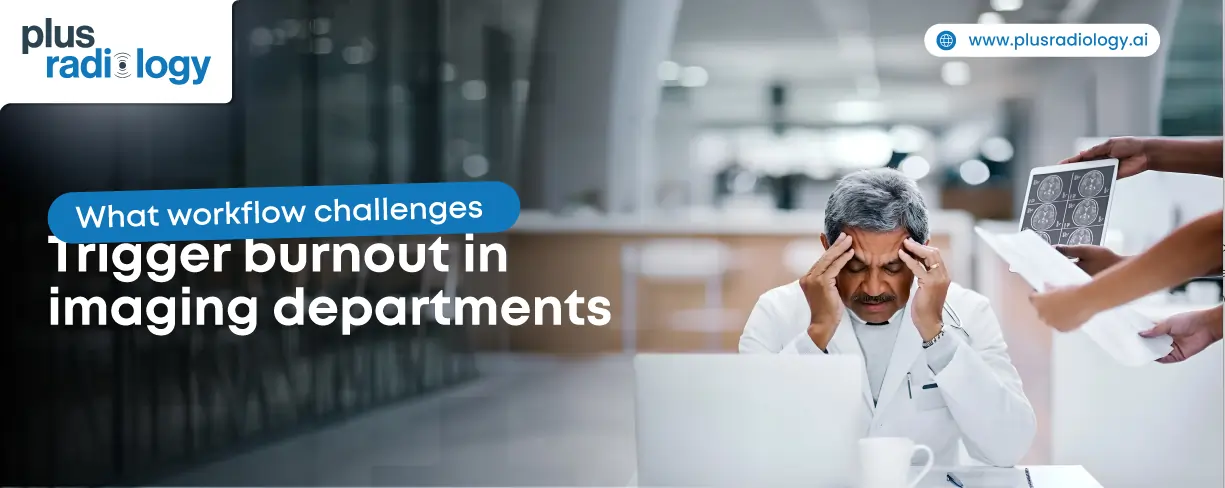
A day in a busy radiology department can feel never-ending. Scans keep coming, reports pile up, and cases line up endlessly for radiologists. Even small interruptions like juggling multiple software or paperwork can slow down the workflow and fuel burnout.
Burnout happens when constant stress leads to complete exhaustion. In radiology, the demand for speed and accuracy is high. Heavy workloads and the requirement for faster imaging TAT cause burnout in radiology staff.
Let’s take a detailed look at the unique challenges related to burnout in diagnostic imaging and identify practical approaches to resolve them, facilitating smoother workflows and healthier work conditions for radiologists.
Top Radiology workflow challenges that cause burnout in imaging departments
Working in the imaging department can be exciting, until demand and staff capacity maintain stability. The minute when demand crosses staff capacity, radiologists will likely face extreme burnout.
Given below are some of the major imaging workflow inefficiencies that cause burnout in radiology staff.
1. Mismanaged Scheduling
When clinics do not have proper management regarding booking imaging appointments, it can lead to radiology workflow challenges. Proper scheduling should keep a balance between patient flow, equipment availability, and staff capacity. Mismanaged scheduling looks like:
- Booking multiple scans without considering the scan duration
- Booking without referring to the availability of equipment and staff
- Booking multiple appointments in the same slot
- Adjusting missed appointments in between any slots
Due to improper scheduling, staff can sometimes face unexpected extreme rush, which makes them feel too stressed and overloaded.
From scan to payment, our software makes radiology billing reliable
2. Excessive Administrative Tasks
It's not just the scans, but there's paperwork too. Staff spend hours entering patient information, updating records, and finding files. Administrative tasks include:
- Manual Data entry of patients into the system
- Verifying patient insurance eligibility
- Paperwork during admission and discharge
- Storing patient details and documentation
- Sharing patient reports with other clinicians
Frequent interruptions due to administrative tasks are a major source of imaging workflow challenges in busy departments. The radiology department experiences major fatigue from performing administrative tasks along with clinical operations.
3. Absence of Integration
Medical imaging centres have to manage a lot of functionality, so they have to navigate between multiple systems, such as scheduling management, imaging platform, and patient data storage platform. Effects of fragmented systems:
- Manually entering patient data into every system
- Chances of duplicate entries
- Radiologists need to switch from one system to another multiple times
- Increases maintenance charges and security risk
Considering all this, the lack of integration in the workflow can create constant interruptions by wasting lots of time in switching. Excessive repetitive tasks reduce the productivity of radiologists.
4. Equipment Bottlenecks and Downtime
When modalities are not available due to unexpected breakdown or maintenance, it can generate imaging department workflow bottlenecks. Pitfalls experienced due to this are:
- Patients have to wait for long hours in the queue
- Delay in reports due to the lack of availability of the modality
- Patients sometimes have to revisit the centre
- Improper maintenance can affect the accuracy of results
Radiology staff will feel frustrated if resistance occurs in their daily routine. This majorly contributes to one of the radiology workflow challenges.
5. Lack of Real-Time Insights into Department Performance
Without a clear view of things like scan times, patient wait times, or reporting delays in radiology, staff may not detect where the problems are. Let’s explore how these create a hindrance in workflow:
- Make the patient wait for a long time
- Can overload a particular radiologist while others are free
- Unexpected breakdown occurs due to the overuse of a particular modality
- Can sometimes face over-hiring and under-hiring problems
Admin staff, radiologists, and technicians can experience an imbalance in workloads, high error risk, and increased delays.
Multi-user access ensures everyone can work seamlessly together
6. Fear of Expected Accuracy and Compliance
Every patient expects that their generated reports are highly precise and are aligned with regulatory standards. Hurdles experienced due to these are:
- Expectation of fast report delivery with zero error
- Slower reporting due to double verification of reports
- Recording every phase manually is time-consuming
- Ensuring the standard format of every documentation
- Regular auditing and accreditation require lots of documentation
The radiology team has to go through lots of pressure to meet all the desires of the patient.
Consequences of Burnout on Imaging Departments
In a highly tense environment like radiology, pressure and stress in the team can directly affect individual mental health and entire departmental performance. Let's explore some of the side effects of burnout:
Rise in Inaccuracy
Due to exhaustion, radiologists lose concentration and focus on their task. In this situation, they are more likely to create mistakes like missing crucial insights while interpreting a medical image.
Slower Report Generation
With lots of cases lined up, generating reports manually after referring to numerous scans becomes time-consuming. Eventually, pointing towards the radiology turnaround time challenges.
Higher absenteeism or resignation
Increasing fatigue and stress make the staff take unplanned leaves frequently, which disrupts the routine workflow. Sometimes, staff resign in search of less stressful and more flexible environments, and for this reason, hospitals have to lose experienced staff.
Lack of Collaboration Between Departments
A frustrated and physically strained person is more likely to show disinterest in teamwork. They will try to create unnecessary problems and will not cooperate with others' opinions. Their participation in group tasks will go on decreasing, leading to breakage in collaboration.
Reduced Productivity
Stress-prone team members will constantly lose interest in their work and will try to do as little as required. They will not try to put in more effort for improving the workflow or for helping other teammates.
Lower patient satisfaction
Slower turnaround time and rising inaccuracy lose the patient's trust and interest in an imaging centre. Due to this, the patient will not choose to revisit, and thus the hospital will be unable to retain regular patients.
Reputation damage
Failure in providing the expected service will definitely affect the reputation. The minute when it becomes hard to survive in the market, the healthcare centre will start suffering from financial instability.
Radiology technologist stress factors often include frequent interruptions and unpredictable emergency cases directing to diagnostic imaging workload problems.
Simplify reporting with one-click summary and discharge generation
Tech-Based Imaging Departments to Reduce Burnout
The good news is we can face these challenges with the help of smart tools. Technology doesn't replace staff instead, it acts as a supporting character. Some of the strategies to reduce burnout in radiology teams are:
Automatic Scheduling and Reminders
Smart software can manage appointments in such a way that patients do not have to wait for long hours in the queue, resources are utilized perfectly, and radiologists do not get stuck in lined-up cases. To reduce the no-show rates, it sends auto-generated reminders. But in case the patient missed their appointment, then it automatically reschedules.
Streamlined Documentation and Reporting
Radiologists don't need to generate a report from scratch, as AI will build a report instantly for them. Automated software for radiology also provides built-in templates for generating reports, which have the facility of input fields, dropdowns, and checkboxes to speed up the generation process.
Automated Alerts and Notifications
Radiology software provides alerts for urgent findings and emergency cases. It also notifies about any pending reports for a long time, scheduled maintenance of any equipment, or any prediction made for the future, such as the need for any highly demanded equipment, the need for hiring more staff, or any abnormal act that takes place inside the system.
Real-Time Workflow Analytics
Visual dashboards show patient flow, machine usage, and turnaround times. Teams can spot the root cause of any problem and make informed decisions addressing imaging department inefficiencies. All the visualizations are updated instantly, making them a real-time entity.
Integrated Systems
Radiology software unifies multiple systems into one platform, eliminating the need for navigating from one system to another. All the software, like PACS, RIS, HIS, and EMR, is embedded into one, so patient data can seamlessly flow between each one. Due to this, a lot of the administrative work of radiologists has been reduced.
Teleradiology
Professionals can easily work from any location, whether it is on-site or remote. Also, patients who are not able to physically visit the clinic can experience the facility of radiology irrespective of time and location.
These solutions act as a powerful tool for the imaging centre to mitigate burnout by maintaining work-life balance amongst the radiology staff.
Making Imaging Departments Healthier and Happier
Hidden Burnout in imaging departments starts with problems of busy schedules, heavy paperwork, poor communication, and machine delays.
With the right tools, it is possible to make work easy, letting staff focus on patients rather than stressing over serving report deadlines, accuracy of outcomes, security compliance, and pending cases.
The goal isn't just to work faster, but to work smarter for the staff. Imaging centres need to focus on why radiology technologists experience burnout. By understanding the causes of burnout in imaging departments, the team can get proper direction to take appropriate actions.
Deal with radiology workflow challenges effectively with our PlusRadiology, an AI-powered Radiology software. It has AI-driven reporting capabilities and clinic process automation, which greatly reduces your workload.
FAQs on Radiology Stress Factors
The main causes of burnout in radiology are busy schedules, too much paperwork, poor communication, and machine delays.
Some of the imaging workflow challenges include improper scheduling, high imaging volume, lack of integration, tons of administrative tasks, and pressure of accuracy & security compliance.
When workflows are not smooth, it creates stress and frustration, due to this it becomes harder for staff to manage time and focus on patients.
Yes, the right tools can help manage scheduling, reduce unnecessary paperwork, and improve communication.

Recent Posts


Is RIS the same as PACS?
June 29, 2026

HIPAA Compliance Checklist for Imaging Centers
June 23, 2026