
What is the Difference Between PACS, DICOM, RIS, and CIS?
Summarize this article with:



Nowadays, healthcare organizations seem to be adopting digital workflows. And why not, as this transition helps them to improve patient experience, reduce administrative burden, and expand services without much effort.
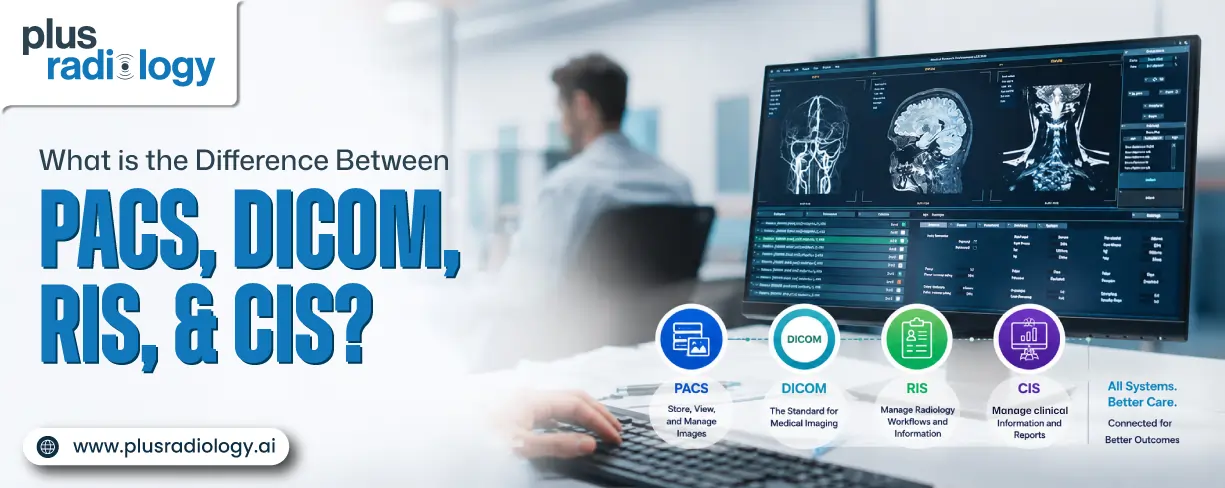
Technologies like Picture Archiving and Communication System, Digital Imaging and Communications in Medicine, Radiology Information System, and Clinical Information System play a pivotal role in this digitization.
Most of the healthcare information systems are developed by integrating these technologies. PACS, DICOM, and RIS contribute to the medical imaging workflow, whereas CIS is responsible for the entire medical journey.
This blog will show you how PACS, DICOM, RIS, and CIS serve different roles in the digital healthcare workflow.
What is RIS?
RIS (Radiology Information System) is software developed to perform administrative tasks and manage the imaging lifecycle. RIS software is responsible for admin-centric services.
It works as a database as well as a workflow management tool. It automates the entire process from receiving examination orders to delivering reports and creating invoices.
Adopting RIS for digital imaging in healthcare will help boost patient experience and reduce staff burnout.
Provide 24/7 diagnostic support with integrated teleradiology workflows
What is PACS?
PACS (Picture Archiving and Communication System) is another specialized software and a core component of digital imaging. It is responsible for managing medical images from the moment it get generated by imaging modalities.
It is useful to store, retrieve, share, and display the medical images. PACS software eliminates the traditional way of capturing internal body structure in physical films.
It comes with a large storage capacity, as the images generated from different modalities are of large size.
What is DICOM?
DICOM (Digital Imaging and Communications in Medicine) is a standard adopted worldwide to store, share, and view medical images. It basically helps in interoperability between different systems within diagnostic imaging software.
With the help of the DICOM standard, images generated from different modalities can easily be shared with other platforms. It eliminates the issue of unsupported file format.
The .dcm extension is used to represent a DICOM file. These files store metadata related to patient personal information, imaging information, pixel data, equipment records, etc.
What is CIS?
CIS (Clinical Information System) is a software that is responsible for gathering, storing, and transmitting the clinical information related to patients.
It can help multiple departments work collectively by automatically transferring the required details to eliminate the manual contacting process. It can also link with medical devices such as a vital sign monitor, ECG, ventilator, etc., and logs the changes in patient condition.
Clinical information system in healthcare automate administrative tasks and boost collaboration amongst different departments.
Deliver better patient care with centralized electronic medical records
PACS vs DICOM vs RIS vs CIS
| Area of comparison | PACS (Picture Archiving and Communication System) | DICOM (Digital Imaging and Communications in Medicine) | RIS (Radiology Information System) | CIS (Computer Information System) |
|---|---|---|---|---|
| Type | Medical image management software | Universal standard for medical image | Radiology process management software | Clinical information management software |
| Functions | Storing, retrieving, displaying, and sharing of images | Standardizing medical images | Order logging & tracking, patient registration, scheduling, reporting, and billing | Managing patient admission, treatment planning, clinical documentation, and the discharge process |
| Type of data that it deals with | Medical images (CT, X-rays, MRIs, etc) | Medical image files and related metadata | Scan orders, appointments, patient personal details, and radiology reports, etc. | Patient's personal details, clinical records, treatment data, imaging data, lab reports, etc. |
| Key users | Radiologists, physicians, technologists | Imaging modalities, PACS, imaging workstations | Radiologists, admin, physicians, patient | Physicians, surgeons, nurses, lab specialists, and admin |
| Integration | DICOM, RIS, CIS, and imaging modalities | Imaging equipment, RIS, PACS, CIS | PACS, CIS | RIS, LIS, HIS, pharmacy systems |
| Department | Radiology | No specific department. Used worldwide in healthcare | Radiology | All medical departments |
| Hardware required | Image storage servers, diagnostic workstations, backup storage, and networking equipment | No specific hardware. Only requires DICOM supporting imaging devices | Servers, storage devices, network tools, and monitors | Servers, storage devices, network tools, and monitors |
| Complexity to operate | High | No direct operation | moderate | moderate |
Read More : HIPAA Compliance Checklist for Imaging Centers
How PACS, DICOM, RIS, and CIS work together
After understanding the key differences between PACS, DICOM, RIS, and CIS, let's discover how they perform their roles throughout the workflow.
-
1. Patient registration and examination: When a patient visits the hospital, his/her details get registered into CIS. A new entry is created only if the patient doesn't exist.
Past medical data is collected and stored in CIS. Physicians examine the patient's current symptoms and past record. -
2. Scan order: After evaluating the patient's condition, physicians ask for any scans or tests, if required. CIS notes the scans that need to be carried out.
-
3. Order management and appointment scheduling: CIS will route all the details related to the patient demographic and scan order to the RIS. RIS will register the patient and log order details. It will also track the order.
Besides, RIS will schedule the slot for the patient after looking at the availability of technicians and the modality. -
4. Medical images are stored: Scan and patient details are transferred to the imaging modality. When the patient goes through a scan, the generated images are attached to the patient demographics and other metadata, following DICOM format.
Then, the images are routed to PACS for storage purpose. Through PACS, these images can be accessed, viewed, and transferred securely.
Enhance coordination and productivity across your radiology group practice
-
5. Report generation: Radiologists generate a report in RIS after interpreting the images. RIS provides multiple tools for report generation.
-
6. Results are shared: Generated report and images are shared with CIS. So that physicians can easily access them.
-
7. Treatment planning and patient care: Physicians can now further make decisions to go ahead with medication only or surgery. At this phase, CIS helps to plan the treatment, generate the prescription, guide the clinical decision, track the progress, and automate follow-up according to the patient care plan.
-
8. Discharge: CIS generates a discharge summary and notifies the required departments about patient discharge so that they can begin the final procedure.
Automatically sends discharge medication prescription to the pharmacy department.
Conclusion
In the digital healthcare ecosystem, PACS, DICOM, RIS, and CIS contribute to streamlining the patient's medical journey. These technologies ensure operational efficiency by enhancing staff productivity and patient satisfaction.
At first glance, understanding the difference between these technologies might seem tough. But it is necessary for the professional practicing in any medical department.
These technologies have distinct roles, but to optimize the medical workflow, they are used together. To gain clarity about each of these systems, one must recognize the interrelation between them.
FAQs
Not always. Most hospitals use all four because they work together to support patient care, imaging, and clinical workflows. However, smaller clinics or specialty practices may only require selected systems based on their services.
No, a Clinical Information System (CIS) is not the same as an Electronic Health Record (EHR). An EHR is a digital patient record that stores medical history, diagnoses, medications, and test results. A CIS is a broader system that uses this information to support clinical workflows, care coordination, decision-making, and patient management across the healthcare organization.
Not if it performs digital medical imaging. Without DICOM, seamless interoperability between scanners, PACS, and other clinical systems would be difficult or impossible.
Integration improves workflow efficiency, reduces manual data entry, enhances communication between departments, speeds up diagnosis, minimizes errors, and provides clinicians with comprehensive patient information for better decision-making.

Recent Posts
Is RIS the same as PACS?
June 29, 2026

HIPAA Compliance Checklist for Imaging Centers
June 23, 2026