
HIPAA Compliance Checklist for Imaging Centers
Summarize this article with:



If you are running an imaging center, then you might have heard the term HIPAA compliance very often. And failing to meet its underlying requirements might cost you a large penalty.
HIPAA Compliance for Imaging Centers includes safeguarding confidential patient data throughout the workflow.
Many healthcare providers are struggling to fulfill the compliance benchmarks and end up being trapped in security risk. But how imaging centers can maintain HIPAA compliance in the absence of a proper roadmap?
Addressing the above concern, this guide delivers all the key considerations for HIPAA compliance, ensuring patient data security in imaging centers.
What is HIPAA Compliance?
The Health Insurance Portability and Accountability Act consists of a series of standards for Protected Health Information(PHI) security. It outlines how covered entities and business associates should interact with confidential patient data. This healthcare data privacy regulation involves the ethical use of patient health information.
Make informed decisions with real-time radiology reporting and analytics tools
HIPAA regulations for healthcare providers come with 3 major rules:
-
Privacy Rule: It involves preventing private patient data from being used or disclosed without informing them.
-
Security Rule: It involves preventing illegal breaches of electronic Protected Health Information by implementing administrative, physical, and technical measures.
-
Breach Notification Rule: It involves notifying the affected party and the team of health & human services(HHS) about the violation of PHI within a defined time limit.
HIPAA Compliance Checklist for Imaging Centers
Patient data privacy violations can take place when medical imaging organizations lack proper guidance to become compliant. Let’s discuss the checklist that makes your imaging clinic HIPAA-ready.
Conduct Regular Risk Assessments
Risk evaluation is one of the essential HIPAA requirements for imaging centers. Radiology workflow involves the transmission of patient information between PACS, RIS, EHRs, cloud, and billing software.
Risk assessment can identify vulnerabilities present in these platforms. This helps to ensure that all the systems involved in the workflow are safe.
Risk evaluation can be beneficial to find where PHI can be violated before it gets too late.
Secure Patient Data Storage
Imaging centers have to deal with a large volume of patient data every day. Because of this, storing patient data in a secure place is mandatory to keep it protected from illegal breaches.
A storage platform must have a strong security mechanism, no matter where patient data is stored (either on a local device or on a centralized entity).
Also, it must have an automatic backup feature with a defined procedure for recovery. So, data can be restored easily when the storage system is hacked or when data is deleted by malicious personnel.
Enforce Role-Based Access Controls
Role-based access control is another popular practice to achieve HIPAA compliance for radiology centers. This approach limits the accessibility rights based on the user’s role.
Role-based access controls help:
- Limit the permissions on confidential patient data
- Implement the minimum necessary principle
- Reduce illegal access activities
Instead of giving full rights to every user, each one gets limited, but all the required permissions they need to perform their duties.
Encrypt Data at Rest and in Transit
For medical imaging data security, encryption is considered to be an effective approach. In this, confidential patient health records get converted from readable to unreadable form.
Only authorized users will be able to read the patient data as they are provided with the decryption key.
Encryption must be applied at 2 stages: the stage in which data is in a stable state, and the stage in which data is being transferred. This ensures that data remains always encrypted. So, an unauthorized user can't access its original form.
Improve operational efficiency with intelligent patient management capabilities
Use Strong Authentication Measures
Authentication mechanisms help prevent unauthorized personnel from accessing the private patient data. HIPAA compliance requires imaging centers to implement identity verification before allowing the user to interact with PHI.
Best practices to implement authentication:
- Include multi-step verification
- Allow only strong passwords
- Allocate unique accounts to each user
- Deactivate inactive accounts
- Limit frequent failed log-in attempts per timestamp
In the absence of proper authentication measures, PHI might be violated, which works as an anti-compliant act.
Maintain Audit Trails and Activity Logs
Audit trails are records that show the activities performed on sensitive patient data, whereas activity logs refer to the data related to events happened within the system.
Audit trails usually store:
- Identity of the user (who performed the action)
- Performed actions
- Date and time of action
- Accessed data
- Previous and modified data (if changes are made)
- IP address of the user (who performed the action)
- Identity of the user who approved the action
Activity logs store:
- User login and logout attempts
- User failed login attempts
- Password changes
- Opening and leaving the system
- System update
Effective HIPAA audit preparation must include all such logs that can define clear accountability. Because of this, it becomes easy to track unauthorized personnel in case of PHI violation.
Train Employees on HIPAA Policies
Educating employees refers to providing knowledge about how to protect sensitive patient information from being violated by achieving all requirements under HIPAA.
Training users is essential because even the strongest security system might fail due to minute human error.
Many security risks arise not because of weak security measures in imaging centers, but because of unawareness amongst users about privacy policies and standards.
Establish Incident Response Procedures
Incident response procedures describe what actions an imaging center should carry out in case the security of PHI is breached.
Only maintaining strong security measures will not be enough. A secure plan is also required that can be enforced when violations of patient privacy occur.
The security incident response plan includes:
- Whom to notify/report about the violation
- How should a violation be notified
- How the notified person should prioritize the reported incidents
- Progress tracking of each reported incident and verifying that no incidents remain unaddressed
- Maintaining documentation of each stage
- Recovering any lost data
- Post-incident verification and applying the required actions based on verification to prevent further violations
Manage Third-Party Vendor Compliance
Sometimes, medical imaging organizations need external service providers to carry out functionalities that are beyond their expertise. This indicates that third-party vendors must be verified before choosing them as a partner.
It must be evaluated that external parties also follow the underlying HIPAA standards so that no sensitive data is harmed.
Instead of relying only on questionnaires, collect legal documents and official certifications to ensure compliance.
Ask vendors for some recognized credentials, such as HITRUST or SOC 2, that can put weight on their security commitment.
And last but not least, make external organizations sign a Business Associate Agreement (BAA). This is a legal document that binds third parties to enforce HIPAA compliance when working with PHI.
Regularly Update and Patch Systems
As technology is evolving, each imaging software needs updates from time to time. Without regular updates, the imaging software can become vulnerable to security threats.
Cybercriminals generally target outdated software because breaking its security wall seems to be a lot easier than an updated one.
Updates are released by the vendor to bring multiple changes into the system. Whereas patch updates are released to solve a single security issue.
Test the update before implementing it into the system. For a secure radiology workflow, perform regular check-ups to identify the need for new updates.
Connect all imaging centers through a unified and scalable software solution
Why Imaging Centers Must Prioritize HIPAA Compliance
Let's look at some of the core reasons behind prioritizing HIPAA compliance for imaging centers.
-
Protecting patient security: By preventing PHI from violation, patients can feel safe and secure. This can boost trust amongst them.
-
Preventing degradation of patient care: Implementing security mechanisms ensures systems never get hacked, and data never gets compromised, helping radiologists to focus on patient care.
-
Avoid legal consequences: Ensuring proper data security can prevent forced clinic closures, sealing of modalities, license deactivation, or large penalties.
-
Maintain a strong position: Strong security in imaging centers can help maintain a recognized market position, eventually leading to progress.
-
Secure teleradiology services: teleradiology includes exchanging imaging data and related reports with physicians and radiologists. HIPAA compliance in radiology ensures safe sharing of imaging data.
-
Enhance accountability: With audit trailing and activity logs, a clear visibility can be achieved of what activities are occurring and who is responsible for them.
Read More : Top 13 Use Cases of AI in Radiology
Building a Secure Future with a HIPAA Checklist for Radiology Practices
It is not easy to establish a compliant imaging center unless proper guidance on achieving HIPAA requirements doesn’t exists.
The day when organizations understand how to ensure HIPAA compliance in imaging centers, the ratio of security threats will suffer a severe downfall.
Whether you are operating imaging centers remotely or onsite, a HIPAA-compliant radiology software and infrastructure is mandatory.
Protecting patient privacy is equally important as providing an accurate diagnosis. So, it is mandatory to prepare each technical entity (PACS, RIS, EHRs, etc.) and the involved staff for security threats in advance.
FAQs
Information like patient personal data, health records, medical service records, and billing & payments details is considered to be PHI.
HIPAA has not mentioned any fixed time period for risk assessments, but it should be done regularly between specific time intervals and also when any changes are done into your systems, workflows, or operations.
Not every cloud platform is HIPAA compliant. Compliance depends on how the platform is managed and also on the vendor who has injected a compliance mechanism into it.
Violation of HIPAA can lead to large fines, license deactivation, sealing of modality, regulatory investigations, imprisonment, and forced clinic closure.

Recent Posts
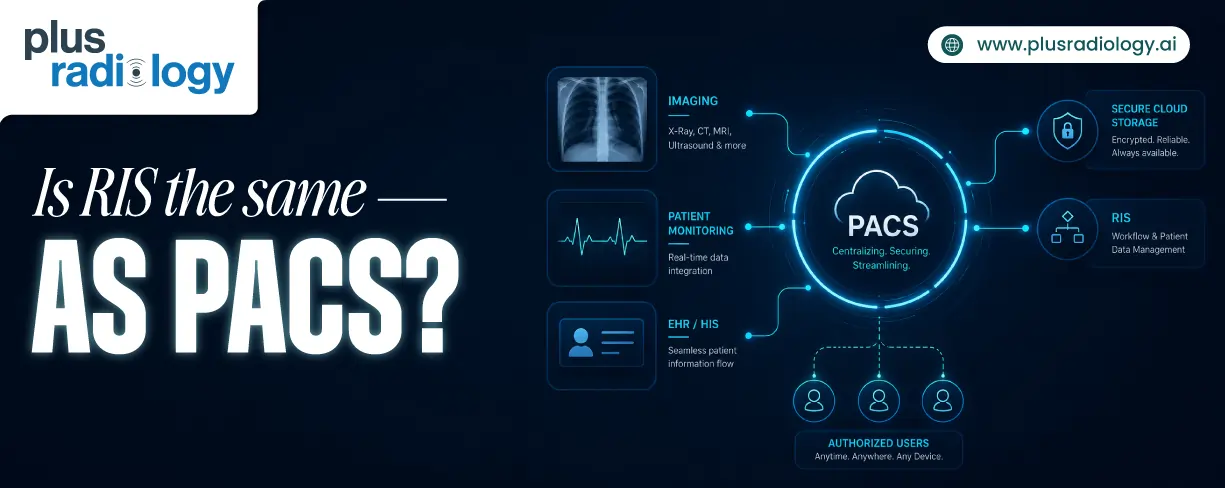
Is RIS the same as PACS?
June 29, 2026
HIPAA Compliance Checklist for Imaging Centers
June 23, 2026