
How can imaging centers implement AI safely and effectively?
Summarize this article with:



- 1. Understanding AI in Imaging Centers
- 2. Steps to Implement Responsible AI in Imaging Centers
- 3. Setting Administrative Framework for AI in Radiology
- 4. Benefits that are Experienced by Integrating AI
- 5. Security Considerations Before Implementing AI
- 6. Post-Integration Impacts
- 7. Upcoming Aspects of AI in Imaging Centers
- 8. Frequently Asked Questions
- 9. Ethical AI - Working to Optimize Radiology
Currently, imaging centers are facing difficulty with increasing workload for radiologists, slower diagnosis, and pressure to serve faster turnaround times for patient satisfaction. To overcome these complexities, healthcare professionals are willing to adopt AI in medical imaging.
To implement AI in diagnostic imaging, you should ensure that technology, patient satisfaction, and clinical operations all stay at the same level. If either one of these gets emphasized over the other two, then it will lead to deterioration in hospitality. So look for best practices for AI adoption in healthcare imaging.
Experience instant diagnoses with embedded electronic medical records.
Understanding AI in Imaging Centers
Nowadays, the imaging center has properly adopted AI to the fullest extent to provide better hospitality. But still concern rules around “How can radiology departments use AI effectively?”
Secure AI solutions for healthcare imaging centers mainly focus on supporting radiologists in quickly analyzing medical images, early detecting abnormalities, and automating report generation without compromising any security matters. Explore some of the use cases:
-
Detection of abnormalities-AI supports radiologists in capturing major as well as minor suspicious anomalies.
-
Automated changes tracking - AI analyzes the dimensions (size, shape, volume) of any lesions.
-
Smart triaging functionality- AI scans the image, prioritizes the case for severe abnormalities.
-
AI-assisted report -AI helps in generating reports from scratch by analyzing medical images.
-
Future prediction for resource planning- AI keeps records of all past data, and provides predictions on future patient flow.
Read More : Top Medical Practice Management Software of 2025
Steps to Implement Responsible AI in Imaging Centers
Before we go ahead, it is necessary to have basic knowledge of the steps to integrate AI into radiology workflows. To implement AI safely in imaging centers, a standard process should be adopted.
Step-1: Assess current operations
Don't directly push AI into the system before pre-checking the existing systems' working.
Give more attention to the factors mentioned:
-
Existing PACS and RIS systems- Check that the existing systems will not face any difficulties in operating with AI
-
IT and data storage functionality- Ensure that the system is capable of providing the necessary IT functionality and storage to run with AI.
-
Staff friendliness- Check for technical knowledge of professionals and staff to work with AI.
-
Current difficulties- Search for areas where AI could make a great impact and reduce the radiologist workload.
-
What benefits will be gained- Identify which phase of the radiology workflow will benefit from the integration of AI.
Step-2: Select an ideal AI tool
Points to be considered while choosing a specific tool to implement AI securely in radiology:
-
Clinically approved-Ensure that the AI solution is clinically tested and approved by professionals in the real world.
-
Follows security standards- Check for adherence to security standards and regulations.
-
Ability to integrate- Evaluate that the proposed AI solution will be compatible with the existing system.
-
Authority of Vendor- Ensure that the vendor is trustworthy in terms of providing proper updates and maintenance.
Step-3: Test before actual implementation with Pilot Programs
Pilot programs refer to the testing phase to check the operability of new technologies before introducing them completely.
Pilot programs facilitate departments to:
-
Test AI behavior in real-world- Assess how AI will react with actual imaging data and other clinical operations.
-
Check for reliability- Make sure that AI will produce accurate and precise results without compromising quality.
-
Identify improvement in workflow- Check that after implementing AI, whether any improvement takes place, which increases efficiency.
-
Take feedback and reviews- Ask for feedback from professionals on the working of AI with imaging systems.
Step-4: Integrate AI with Existing Systems
As it is mentioned above that capacity to integrate matters the most to experience seamless operation.
This typically includes integration with:
-
PACS (Picture Archiving and Communication System)- Allows AI to instantly retrieve the stored images and helps to interpret them.
-
RIS (Radiology Information System)- Helps AI to get in touch with arranging appointments, generating reports, tracking user activity, and patient management.
-
EHR/EMR (Electronic Health Records)- Allows for connecting AI-generated outputs with actual patient records.
Perfection in integration allows AI for diagnostic centers to contribute directly to the radiology workflow
Step-5: Educate Staff and train them to evolve
Train staff regarding:
-
How AI algorithms analyze medical images- Inform the staff regarding the working of AI in detecting abnormalities.
-
How AI results contribute to PACS system- Educate radiologists on how AI helps in displaying and storing images.
-
How to verify AI results- Instruct radiologists to validate AI outputs with their own results to ensure its accuracy.
Secure AI for healthcare imaging will never cross its limit.
Stay on schedule and updated with brilliant alerts and reminders.
Setting Administrative Framework for AI in Radiology
AI makes a greater difference in medical decision-making, so if it produces incorrect output, then it will directly affect the patient's outcome. Because of this, there is a need to establish a governance framework to ensure safe AI adoption in healthcare.
Build an AI Monitoring Committee
An AI tracking team should be responsible for overseeing all aspects of clinical operations where the touch of AI is present. To experience secure AI integration for imaging centers, a strong department should exist who look after “what are safe ways to implement AI in imaging centers?”.
It should consist of:
-
Radiologists- Provide clinical expertise and ensure AI supports accurate diagnoses. Guides in reviewing clinical tasks and provides reassurance about outputs.
-
IT specialists- Manage the interoperability between different systems and are responsible for any technical errors.
-
Data scientists- Track the mechanisms of the AI models and predict future risk.
-
Compliance officers- Observes that AI models strictly follow healthcare regulations and security standards.
It is important to be cautious even after the effective integration of AI in radiology to prevent accidental risk that can be difficult to mitigate.
Define Final Liability and Risk Management
In case if AI-outputs gets differ from the radiologist's interpretation at that time, there should be clarity on who will be responsible for the final decision.
Medical imaging centers should have clarity on:
-
Liability for final decision- Radiologists have the authority to decline AI results and are responsible for the final output.
-
Procedures for resolving conflict- Define a structured set of steps to follow when conflicts in the output of AI and professionals take place.
-
Pre-management for AI system failures- Be prepared for multiple backup options in case of any accidental technical crisis.
Establishing unbiased and strong administrative regulations to oversee the working of AI can help in smooth operations.
Real Time Performance Monitoring
Due to the integration of AI in imaging systems, performance should be evaluated regularly to ensure that the system is not losing its efficiency.
Regular performance tracking should include:
-
False rates - Evaluate the amount of false positives and false negatives to know the ability of AI models to produce true output.
-
Performance with increasing volume - Monitors performance while increasing the population to ensure constant effectiveness.
-
Workflow efficiency improvements - Observe that AI is enhancing clinical operations like scheduling, reporting, billing, and recovery tracking.
Regular periodic checkups for effectiveness and efficiency enhance patient satisfaction.
Benefits that are Experienced by Integrating AI
AI can entertain with many benefits if responsible utilization is done by the healthcare industry:
Faster Image Analysis
Compared to humans, AI can analyze images much faster, which further reduces report turnaround times. Hence, more focus is given to patient care.
Enhanced Accuracy
Due to the presence of AI, the problem of missed findings reduces, leading to an increase in accuracy. Errors generated through human burnout also get eliminated, as AI has no physical limitations.
Lifecycle Improvement
AI simplifies the entire imaging workflow, helping radiologists as an assistant for reducing administrative tasks. Due to this, radiologists experience less workload.
Reduced Radiologist Burnout
With AI's contribution to administrative tasks, the pressure of workload on radiologists reduces. This allows them to pay attention on patient recovery.
Gains Patient Trust
Better patient care, faster recovery, and strong security allow patients to return to your service again and increase the trust amongst them.
Security Considerations Before Implementing AI
Besides experiencing all the facilities of AI, healthcare professionals should not forget to be aware of the harmful side of AI. Hence, it is necessary to understand how imaging centers ensure AI compliance and security.
Adherence to Regulatory Compliance
To save from legal penalties, data breaches, and loss of reputation, imaging centers should make sure that they are completely following security standards (HIPAA, GDPR).
Imaging centers should consider:
-
Patient consent - Should ask for patient permission to use their data for research or training purposes.
-
End-to-end encrypted - Patient data should be encrypted while it is stable (stored) and when it is in transmission.
-
Limitation on accessibility - Define accessibility rights for every user based on their roles.
Safeguarding patient records can help in building trust and retaining the patient.
Evaluate Biasness in AI Algorithms
There can be chances that AI produces an inaccurate result for a specific group of patients based on some characteristics. This occurs due to unbalanced training data provided to AI.
It is necessary to produce fair results for all groups of patients because false output can lead to wrong decisions. Healthcare professionals should regularly calculate the rate of bias and take immediate action to improve it if detected.
Clinically Validated and Approved
Before making AI live in the imaging system, it is necessary to test for its accuracy. It should be tested with actual patient records, not just sample data. This procedure checks for its validity in the presence of medical professionals.
After this, it should be presented to regulatory authorities for actual approval to make it live. At this stage, all the proof of its validity is showcased, based on which authorities grant permission.
Reasonable and Transparent
A trustworthy AI algorithm produces output that is completely accurate and aligns with the actual expected output of radiologists. Not only this, but AI models are also responsible for providing the reasoning behind a particular output. In short, they should give logical and straightforward results.
Instant and paperless patient discharge with advanced radiology workflow.
Post-Integration Impacts
Only focusing on how imaging centers can adopt AI safely will not work; you should also think about what impacts it will create.
The factors that need to be compared are:
-
Diagnostic precision - Improvement in detecting complex abnormalities more accurately.
-
report turnaround time - AI models take less time in analyzing images and generating reports.
-
Radiologist efficiency - As radiology workflow gets automated, a reduction in the workload of radiologists is seen.
-
Patient experience - Due to accurate and quick results, patients experience a fast recovery, enhancing satisfaction levels.
-
Operational return on investment (ROI) - Due to AI, many financial operations have been improved, leading to an increase in income flow.
Upcoming Aspects of AI in Imaging Centers
As you know, technology is not stable in terms of evolution. So the future of AI will surely bring new opportunities in the field of medical imaging.
Some of them can be:
-
Multimodal AI systems - These are the models that produce results by simultaneously referring to multiple images, not just one.
-
Federated learning - It refers to providing training to AI models without sharing sensitive patient information.
-
Personalized treatment - Based on medical images and past all reports, AI will suggest the best possible treatment plans.
-
Constant improvement - While analyzing images, AI learns alongside; because of this, progress will keep on increasing.
Frequently Asked Questions
Patient records are never shared without security. If the patient grants consent, then proper care is also taken to hide the patient's personal information.
Ethical AI helps in analyzing images, scheduling, tracking progress, report generation, and last but not least, secures patient data.
Before complete integration, AI models are sent to the testing phase in real-world environments to check for accurate results.
In case of collisions, the final decision stays in the hands of radiologists whether they want to decline the output or accept it.
Ethical AI - Working to Optimize Radiology
Artificial intelligence is a great tool in enhancing radiology, along with continuous improvement. In today’s world, it is necessary to be in alliance with technology to improve AI adoption strategies for radiology. AI-enabled medical imaging allows to transform a manual, time-consuming process into an advanced digital one. But to experience the good side of AI, it is necessary to make responsible and ethical use of it.
To take advantage of instant diagnosis, accurate results, and quick reporting guided by responsible AI, consider exploring PlusRadiology.

Recent Posts
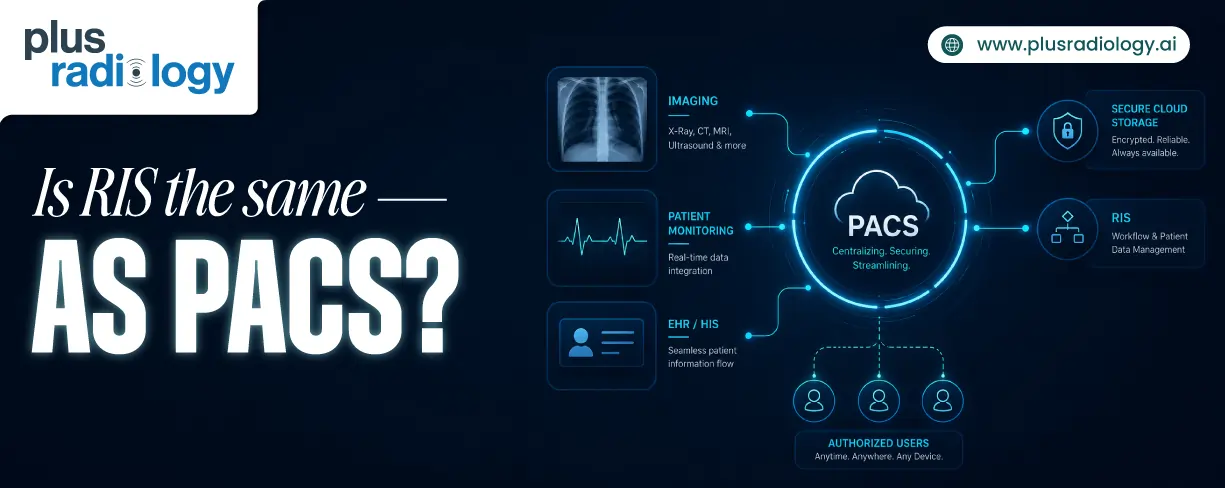
Is RIS the same as PACS?
June 29, 2026
HIPAA Compliance Checklist for Imaging Centers
June 23, 2026
AI for Radiology Reporting: How NLP Transforms Reports
April 29, 2026