
Why Oncology CT Imaging Needs a New Generation of AI
Summarize this article with:



- 1. CT Imaging Oncology: The Era of Modern Cancer Care.
- 2. Challenges of Traditional AI in Oncology CT Imaging
- 3. Traditional AI: Falls Short in Oncology.
- 4. Visualizing Cancer Care with Next-Gen AI.
- 5. Influence on Stakeholders
- 6. Future Scenario of Next-Gen AI in Oncology
- 7. Traditional AI to New-Gen AI: A Journey of Evolution.
- 8. FAQs
As per recent reports, CT imaging has increased by nearly 90% over the last few years. This shows how radiologists are working under constant pressure to manage a growing number of imaging reports while maintaining speed, accuracy, and consistency in diagnosis.
Although AI supports cancer detection, traditional AI for oncology often focuses only on basic findings and is insufficient for complete diagnosis and treatment planning. It also misses deeper clinical insights needed for better cancer care.
This is where the new generation of AI in oncology plays an important role in solving imaging challenges. Next-gen AI in oncology can continuously learn, analyze multiple organs, and support better clinical decisions, helping in redefining oncology CT imaging from start to finish.
In this article, you will learn about the role of CT imaging in oncology, the limitations of traditional AI, and how next-generation AI is improving cancer care for patients, radiologists, and healthcare providers.
CT Imaging Oncology: The Era of Modern Cancer Care.
Out of all imaging equipment, Computed Tomography machines are designed specifically to detect malignancy towards cancer. It is considered to provide an inside body visualization to identify cancerous cells. Let's dive deeper to know where CT imaging contributes:
-
Accurate diagnosis: CT imaging can help distinguish between non-cancerous and cancerous cells to get certainty about the outcomes.
-
Premature tumor detection: It can act as good equipment in detecting cancer at an early stage before it gets worse.
-
Finding tumor stage: Through CT imaging, oncologists can determine the level of tumor a particular patient is suffering from.
-
Identifying recurrence: After treatment, it can scan the body for the purpose to identify the possibility of detecting cancer again.
-
Monitoring progress: It can be used to track changes in tumor size and shape over time, to know whether the treatment is responding in a positive direction or not.
CT scans are considered a central tool for oncologists to make an informed decision that turns out to be in favor of the patient's betterment.
One platform. Multiple locations. Get complete control over your imaging network
Challenges of Traditional AI in Oncology CT Imaging
Even with tremendous advances in the detection of tumors with AI, its usage in oncology CT imaging falls apart due to some limitations.
-
Attending rare situations: If AI is trained on a limited dataset, then it might take longer to respond, and can give uncertain output for not familiar cases.
-
Less contribution to clinical workflow: AI in Computed Tomography imaging fails to identify the interrelation between multiple scans, which oncologists must find on their own. This shows that AI is not effective for clinical tasks.
-
Lack of detailed interpretation: AI agents are designed to identify the tumor, but not to provide the cause and consequences behind it.
-
Imperfect progress measurement: AI is unable to compare all the scans chronologically and fails to detect the change in characteristics of the tumor based on the treatment carried out.
-
Not guaranteed accuracy: Oncologists have to consider a final check by verifying the AI outcome, as AI’s output is not always accurate.
-
Severe burnout in oncologists: AI fails in providing support in most of the clinical tasks, due to which oncologists are facing exhaustion in serving large volumes of cases.
These are some challenging pain points that, if ignored, can delay diagnosis and affect patient care.
Traditional AI: Falls Short in Oncology.
Early AI builds a good base for developing tech-based oncology imaging, but it still faces a downfall in delivering better cancer care due to some unresolved complexities, such as:
- Early AI models are static learners. They need to be retrained repetitively as oncology has to face uncommon cases very commonly.
- Today's AI models are designed for a narrow view, so oncologists have to set connections between each view, which again is a time-consuming task.
- Current AI can easily find an anomaly, but can't define the reason for its occurrence, its impacts, or its severity.
- Uncertainty doesn't stop AI from giving output. It provides a result even if it is not certain.
- Early AI for oncology imaging measures progress by comparing some of the past reports & scans without considering the treatment outcome.
Traditional AI is best at detecting, but oncology is a vast field that can’t be limited to only detecting.
From data to decisions—seamless reporting and analytics.
Visualizing Cancer Care with Next-Gen AI.
Now, if technology is developing, then cancer care must develop. This can be done by adopting advanced AI into the oncology workflow. Let’s view what changes a new generation AI for oncology can make:
- New-gen AIs are continuous learning models. They keep on improving on their own from the new data that they face.
- No fragmented solutions. They can visualize different organs’ findings that are interlinked to each other.
- Advanced AI for cancer imaging evaluates progress by comparing all previous and current studies, along with considering treatment outcomes. It focuses on detailed characteristics of the tumor rather than just shape and size.
- Next-gen AI in oncology provides personalized treatment plans by understanding the patient rather than just referring to patterns.
- These AIs are completely aware of the uncertainty and sometimes ask oncologists for their judgment, rather than giving false output.
Improve the practice of oncology with a new generation of AI, which goes beyond detection by addressing all oncology imaging challenges.
Influence on Stakeholders
By introducing next-gen AI in oncology, radiologists and oncologists can make faster decisions, deliver faster turnaround time, plan better patient care, and manage work-life balance.
Patients feel satisfied with precise and more personalized treatment plans, accurate results, and on-time service.
When patients and radiologists/oncologists are satisfied, healthcare providers will likely attract a more targeted audience through their service.
Future Scenario of Next-Gen AI in Oncology
New-Gen AIs are progressing continuously to utilize the technology to a far extent. Looking into futuristic oncology, new-gen AI will have gone too far in treating cancer patients. It will act as an end-to-end reasonable entity, responsible for giving a valid explanation to every decision it makes.
Personalized treatment plans will get more precise and proactive due to the involvement of multi-omics data, which visualizes the patient from the foundation of the body.
On top of this, the usage of the Internet of Medical Things (IoMT) will act as the breaking point in supporting real-time decisions. Also, there are ongoing experiments for inventing digital twins to replicate a real individual testing drugs, therapies, and treatments to prevent risking a person’s life.
Simplify team collaboration with secure multi-user access control.
Traditional AI to New-Gen AI: A Journey of Evolution.
Now, clear visibility is gained on what the best AI for oncology should look like. Rather than just identifying defects, it should learn to understand the patient. AI for personalized cancer treatment Should be responsible for modifying the treatment based on changes observed. So, when we are looking for AI, we are expecting it to act as a broad viewer that is not limited to analyzing one organ at a time.
We expect AI to handle uncertainty without giving false or misleading results, because oncology deals with many complex and unfamiliar cases every day. The ability to understand connections between insights, continuously learn from new data, and perform long-term evaluation makes AI a perfect fit for oncology.
To reach ideal AI solutions, technicians and doctors need to work together. Technicians should brainstorm themselves like doctors, and doctors should provide proper feedback to technicians after connecting with technology.
FAQs
Traditional AI lacks comprehensive interpretation, focusing only on detection. Additionally, it is a static learner that needs frequent training and is meant for narrow visibility. It performs a short-term evaluation and hides uncertainty.
Next-gen AI refers to current as well as past patient records and treatment responses to suggest any care plans. Also, based on changes detected, plans get modified accordingly.
New generation AI for oncology can turn unstructured, unformatted data into actionable, structured data, which machines can read and interpret easily.
New-gen AIs are designed to integrate easily with software such as PACS, RIS, and EMR so that no disruption in operation is experienced by oncologists/radiologists.

Recent Posts
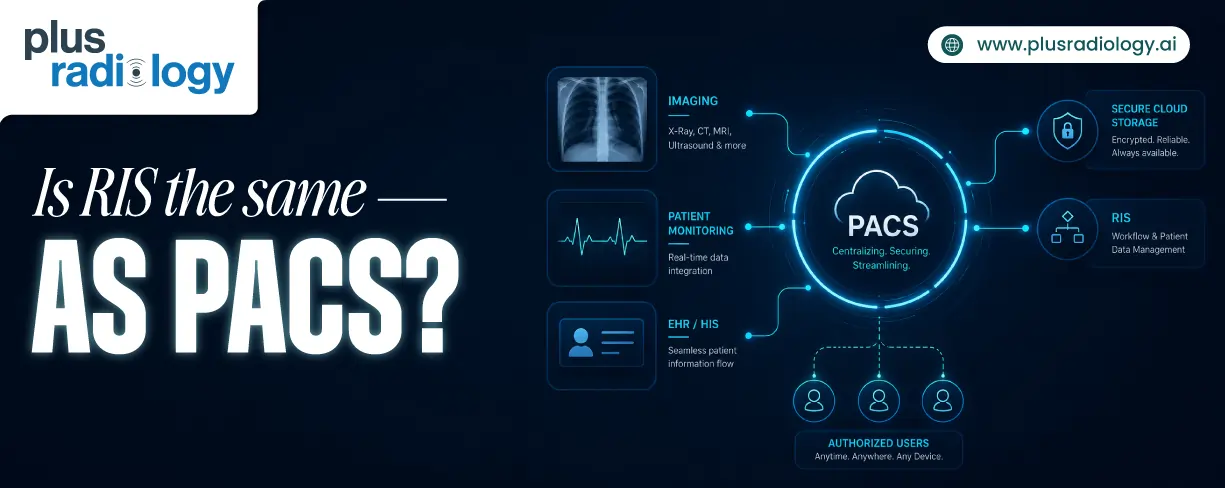
Is RIS the same as PACS?
June 29, 2026

HIPAA Compliance Checklist for Imaging Centers
June 23, 2026