
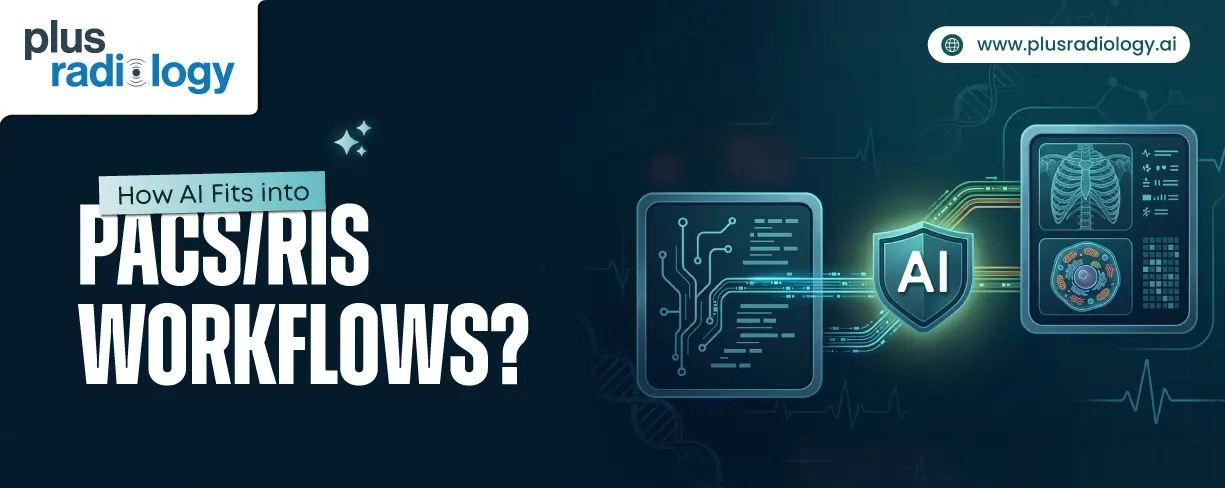
How AI Fits Into PACS/RIS Workflow?
Summarize this article with:



- 1. What is PACS?
- 2. What is RIS?
- 3. How hospitals can inject AI into their PACS/RIS
- 4. Where AI Integrates into the PACS and RIS Workflow
- 5. AI + PACS/RIS Architecture Overview
- 6. Key Benefits of AI in PACS/RIS Workflow
- 7. Real-World AI Use Cases in Radiology
- 8. Points to Remember Before Making AI Part of PACS/RIS
- 9. Frequently Asked Questions
- 10. AI for PACS/RIS Workflows - Conclusion
AI in Radiology is suddenly the talk of the town. Everyone's buzzing about medical imaging, and for good reason.
AI helps the imaging centres keep the right balance between handling a large volume of scans and their turnaround time without compromising on accuracy.
Talking about AI in PACS workflow, it contributes to safe and secure storage of patient records as well by keeping regular audit logs.
In this blog, we will look into AI reshaping radiology workflows (RIS/PACS processes), beginning with:
- Current scenario of PACS and RIS in the radiology domain
- How to Integrate AI with PACS and RIS Systems?
- Contribution of AI in enhancing reporting accuracy and turnaround time
- Real-world clinical use cases
- Important factors to consider during implementation
Experience the ease of seamless teleradiology services with AI-powered PlusRadiology
What is PACS?
PACS (Picture Archiving and Communication System) is a software that replaces the traditional method of storing tons of physical files with digital image storage. AI in PACS workflow facilitates the instant retrieval of images and ensures safe sharing between departments.
Key Functions of PACS:
-
Centralized Image Storage Platform: Stores CT, MRI, PET SCAN, and X-ray data with tight security, besides ensuring the quality doesn't degrade.
-
Immediate Access to Documents: Access any patient history on the spot instead of manually searching for lots of physical records.
-
Level-up DICOM Imaging: Provides advanced tools to visualize, adjust, and compare DICOM images, enabling specialists to interpret the image with ease.
-
Improves Collaboration: Ensures safe and smooth exchange of reports within various departments to promote better coordination.
It transforms radiology from traditional physical scans to modern digital imaging scans. AI in PACS workflow can provide a new look to the imaging centers.
Read More : Top Medical Practice Management Software of 2025
What is RIS?
RIS acts as a record keeper that manages patient records from the beginning. It is also responsible for scheduling appointments and generating reports. It is built to serve the purpose of managing the patient data from beginning to end. By injecting AI in RIS workflow, managing the medical journey becomes easy for both radiologists as well as patient.
Key Functions of RIS:
-
Managing Patient Records: Responsible for capturing the patient information and storing it in the system so that no unassociated documents are generated.
-
Supports Scheduling: Automatically checks the availability of specialists and equipment to arrange the slot. It can also send reminders to reduce no-shows.
-
Facilitates Report Generation: Eliminates the need of typing report from scratch through structured AI-powered radiology reporting, which leads to a shrinkage of turnaround time.
-
Monitors Billing Operations: Handles billing operations to avoid revenue leakage and ensure secure transactions.
To modernize the radiology workflow, PACS and RIS contribute equally well, focusing on the responsibility to optimize the entire medical lifecycle.
How hospitals can inject AI into their PACS/RIS
- Hospitals can start small by plugging simple AI tools into their existing PACS/RIS - no massive overhaul needed.
- Once the basics work smoothly, they can roll out AI in medical imaging workflows for reporting, triage, and routing to ease the radiology operations.
- The trick is to pilot, learn, tweak, and scale - AI fits best when it grows with the workflow, not against it.
Where AI Integrates into the PACS and RIS Workflow
AI can be integrated with PACS and RIS to work alongside, eventually enhancing the existing workflow at multiple stages.
And here's exactly how this happens.
Manage your Radiology team better with PlusRadiology's multi-user access
1. AI at Image Acquisition Stage
AI can integrate directly with imaging modalities, supporting radiologists even before the images reach the reporting stage.
Common use cases include:
- Automated image quality assessment
- Motion artifact detection
- Intelligent protocol selection based on patient data
- Optimization of radiation exposure levels
AI for PACS systems ensures that images entering scans are already optimized for accurate diagnosis.
2. How AI Enhances Image Analysis Inside the PACS
This represents the primary integration point for AI within radiology systems. AI for faster imaging turnaround time facilitates scanning tons of images in a shorter period.
An AI model reviews images that PACS consists of and can:
- Identify major abnormalities in less time
- Highlight areas of concern
- Generate heatmaps
- Measure lesion size and progression
- Automate clinical measurements
Hence, automate imaging workflows with AI to detect anomalies at early stages and take necessary action on time.
3. AI-Powered Worklist Prioritization (RIS Integration)
AI also integrates with the RIS to streamline and optimize radiology workflows. AI for RIS systems is responsible for balancing the workload amongst radiologists.
With AI integration, radiology teams can:
- Automatically prioritize urgent and critical cases
- Reduce report turnaround time (TAT)
- Route studies to the appropriate subspecialty radiologists
- Identify duplicate or incomplete records
This can be recognized as AI-enabled workflow orchestration. So, AI in RIS workflow is considered to be responsible for end-to-end management of clinical operations.
4. AI in Structured Reporting
AI helps to build a professional report with interactive built-in templates, having the facility of some input fields (dropdown, checkbox) to speed up the process.
AI in reporting can make a greater impact, such as:
- Automatically generate structured report templates
- Optimize voice-to-text transcription
- Suggest standardized medical terminology
- Pre-fill measurements directly into reports
This ultimately enhances:
- Clinical reporting accuracy
- Standardization across reports
- Faster and more efficient documentation
5. AI Analytics & Quality Monitoring
Beyond image interpretation, AI plays a powerful role at the operational level of radiology.
With AI integrated into PACS and RIS, departments can:
- Track radiologist productivity in real time
- Identify reporting delays and workflow gaps
- Monitor diagnostic discrepancies
- Predict imaging demand based on historical trends
This is how AI improves radiology workflows by enabling data-driven radiology management, efficient operations, accountability, and strategic planning.
AI + PACS/RIS Architecture Overview
In a modern radiology environment, the workflow typically follows:
Imaging Modality -> PACS -> AI Engine -> RIS -> EHR
AI can be deployed in multiple ways depending on infrastructure needs:
- On-premises server deployment
- Cloud-based AI platforms
- Vendor-integrated AI modules
- AI integration through external platforms
A strong work-based connection is established between different healthcare systems due to standardized communication protocols such as DICOM, HL7, and FHIR.
Key Benefits of AI in PACS/RIS Workflow
Faster Triage
Using AI for faster case triage speeds up the process of analyzing the cases, prioritizing them based on urgency, followed by assigning them to an appropriate specialist.
Boost in Accuracy
Reduces the possibility of errors while diagnosing by detecting minute findings, providing consistent results, and analyzing images in depth.
Radiologist Burnout Reduction
Reduce radiologist workload with AI by evenly distributing cases. Because of automating repetitive measurements and documentation, AI allows radiologists to focus on complex clinical interpretation.
Standardized Reporting
AI in RIS workflow acts as an assistant to create a report from medical notes and images, eventually reducing burnout for radiologists. It follows a uniform template to maintain consistency.
Scalable Imaging Operations
AI enables departments to handle large patient flow without hiring more staff during peak hours.
Real-World AI Use Cases in Radiology
AI is no longer a choice, it has become mandatory in radiology. It is constantly evolving the imaging center by leveling up decision-making power and accuracy. Have a look at some real-world applications of it:
-
Lung cancer detection: AI can analyze a chest scan to capture minute nodules that might be unnoticed within seconds, helping to take action on the spot.
-
Stroke identification with triaging: AI identifies the stroke or hemorrhage in CT or MRI and prioritizes the case based on severity, besides assigning a deserving professional.
-
Improved mammography screening: Better quality mammogram images lead to early detection of breast cancer, reduce false negatives and false positives, and improve decision making.
-
Capture Fracture in X-rays: Medical imaging AI tools guide in searching for fractures and predicting the recovery time it will take to heal. It will also compare the before and after recovery results.
-
Tumor dimension analysis: AI models are very quick at calculating the size and volume of a tumor for further treatment plans before it turns into a severe anomaly.
Never miss updates with PlusRadiology's automated alerts & notifications
Nowadays, these services are perfectly fitted inside AI-enabled medical imaging entities for boosting patient outcomes.
Points to Remember Before Making AI Part of PACS/RIS
Prerequisites to focus on before embedding AI in radiology workflow, which are important for smooth operation.
Interoperability
Make sure that AI models are trained to accept your existing PACS and RIS systems environment to prevent any performance break.
Strict Compliance
Check that your platform adheres to universal healthcare standards and certifications.
Data Security
Protect patient data by securing image transmission, storage, and system access.
Clinical Approval
Allow usage of only AI tools that are tested in real-world environments and are verified by clinical professionals.
Change Management
Train radiologists and staff to adopt evolving nature of the world to survive in the market.
Ultimately, AI should give a new transformation to our traditional radiology workflow by adopting automation and should elevate the medical domain to another level.
Frequently Asked Questions
To integrate AI, you just need to connect the AI engine to PACS through DICOM routing or API connection so it can analyze images and give output.
No. AI in radiology workflow acts as an assistant to carry out clinical operations, but the final output will always remain in the hands of radiologists.
AI helps minimize manual PACS/RIS tasks, early detection of abnormalities, automates report generating, tracks recovery progress, and simplify discharge process.
AI can easily work with PACS and RIS systems in order to enhance accuracy in diagnosis, improve patient satisfaction, and reduce radiologists' burnout.
AI for PACS/RIS Workflows - Conclusion
AI turns the slow, manual clinical workflow into an advanced, digital workflow, without disrupting the regular medical lifecycle.
AI in radiology workflow contributes to every step, which covers:
- Analyzing images stored in PACS
- Smart prioritization of the worklist
- Structured and standardized reporting
- Radiology workflow orchestration
- Real-time performance tracking
Being a part of the healthcare industry, levels up the clinical operations by accepting AI models to be a part of PACS and RIS workflow. Radiology workflow automation helps to reduce diagnostic error, eventually improving the treatment decision for patient recovery.
Want to use AI in your imaging processes? Adopt PlusRadiology - an AI-powered Radiology software that simplifies your clinical processes. Explore plans here.

Recent Posts
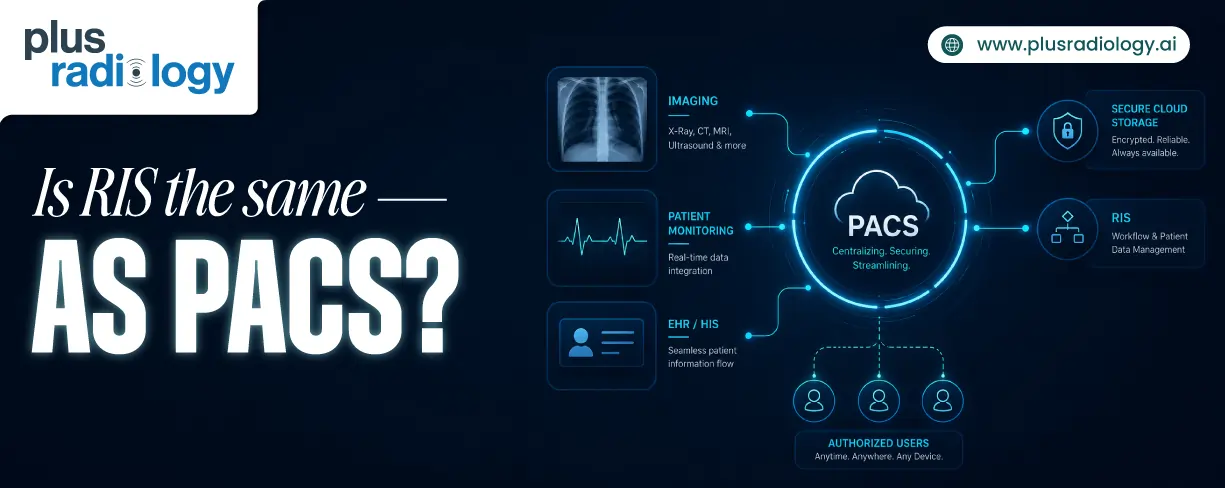
Is RIS the same as PACS?
June 29, 2026
HIPAA Compliance Checklist for Imaging Centers
June 23, 2026
AI for Radiology Reporting: How NLP Transforms Reports
April 29, 2026